
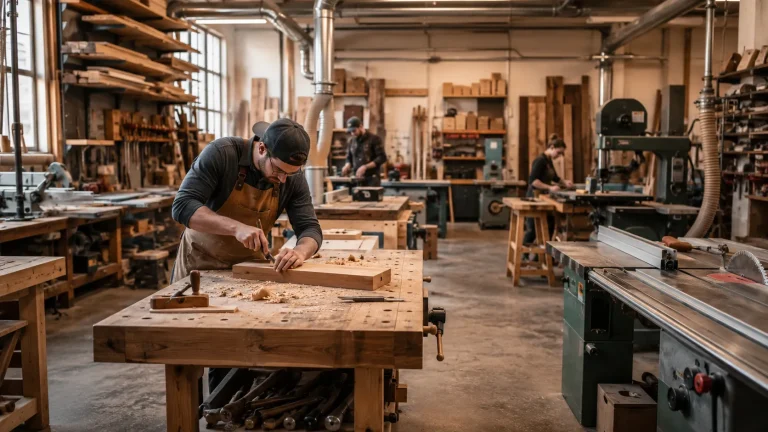
A woodworking shop rental gives you temporary or membership-based access to workspace, machines, dust collection, and other facilities without building a home shop. Depending on the facility, you may pay by the hour, day, month, class, or project. Search for a shared woodshop, community workshop, makerspace, tool library, or open studio near you, then verify that it permits your project and provides training on the machines you need.
This guide explains where to look, what to ask before paying, and how to compare the real cost of a shared shop with working at home. WoodworkCenter does not rent workshop space and is not affiliated with the facilities or directories mentioned below.
Quick answer: how to find a woodworking shop rental near you
- Search Google Maps for woodworking shop rental near me, shared woodshop, community woodshop, makerspace with woodshop, and open woodworking studio.
- Check a makerspace directory, local woodworking guilds, adult-education programs, community colleges, art centers, and tool libraries.
- Confirm that the facility has a genuine woodshop. Many makerspaces focus mainly on electronics, 3D printing, or laser cutting.
- Ask whether a tour, orientation, safety class, or machine certification is required before independent use.
- Describe your project, materials, largest workpiece, machines needed, and expected number of shop hours.
- Compare the complete cost: access fee, training, consumables, storage, machine time, and any required membership or insurance.
- Tour the shop before committing and inspect its machines, guards, dust collection, work areas, and supervision.
What does “woodworking shop rental” mean?
The phrase can describe several different arrangements. Understanding the difference prevents a wasted trip or an unsuitable membership.
| Type of space | How access usually works | Best suited to |
|---|---|---|
| Shared woodshop or community workshop | Membership, day pass, or scheduled open-shop sessions | Hobby projects, furniture, skill development, and occasional use |
| Makerspace | Membership plus orientation or certification for individual machines | Projects combining woodworking with digital fabrication, metalwork, or electronics |
| School or training shop | Access through a class, supervised lab, or continuing-education program | Beginners who want instruction and structured supervision |
| Private bench or studio rental | Dedicated bench, bay, or room rented for a fixed period | Frequent users, professionals, and projects needing storage |
| Instructor-owned workshop | Private lesson, guided build, or limited open-shop access | A specific project or technique requiring expert help |
A conventional commercial unit or garage advertised “for rent” is different. It may provide empty floor space but no woodworking machines, dust collection, electrical capacity, noise permission, or suitable insurance. Do not assume that a normal industrial lease permits woodworking.
Where to look for a shared woodshop
1. Use several local search terms
Facilities do not all describe themselves as woodworking shop rentals. Search your city, county, and nearby metropolitan area using variations such as:
- shared woodshop
- community woodshop
- woodworking makerspace
- open shop woodworking
- woodworking studio rental
- woodworking bench rental
- woodworking co-op
- woodworking classes with open shop
- tool library with workshop
Map results are useful, but check the facility’s own website or contact it directly. Listings, hours, equipment, and access policies can change.
2. Search makerspace directories
The community-curated Make: Makerspace Directory and the international Blacktail Studio Makerspace Database can help identify possible facilities. Treat a directory result as a lead rather than proof that public woodshop access is currently available.
3. Contact local organizations
Woodworking guilds and clubs often know about member shops, supervised sessions, or instructors willing to host a project. Also check:
- community colleges and adult-education departments;
- municipal recreation programs and public libraries;
- art centers, sculpture studios, and craft schools;
- Habitat for Humanity affiliates and repair organizations;
- cabinetmaking or furniture schools;
- local lumberyards and independent woodworking stores.
Even when an organization does not rent space itself, it may know the nearest active community shop.
Questions to ask before you rent
Send the same short project description to each candidate so that you can compare answers. Include the type of item, approximate dimensions, material, machines you expect to use, your experience level, and your desired dates.
Access and supervision
- Is access available by the hour, day, open-shop session, or membership?
- Must a monitor or staff member be present?
- Can members reserve workbenches and machines?
- Are evenings and weekends available?
- Is there a minimum age or guest policy?
- Can a first-time visitor tour the shop before joining?
Training and machine authorization
- Which orientation or safety courses are compulsory?
- Does each major machine require a separate certification?
- Can prior experience replace training, or must every new member be checked out?
- Is instruction included in the access fee?
- Who can help if a setup or cut is beyond your current ability?
Project and material restrictions
- Are reclaimed, painted, pressure-treated, pallet, or nail-contaminated boards prohibited?
- Can you work with MDF, plywood, epoxy, resin, finishes, or solvent-based products?
- Are there limits on slab size, log processing, sanding, turning, or spray finishing?
- May you run a commercial business or produce items for sale?
- Can unfinished projects and lumber remain in the building?
These rules protect people and equipment. For example, hidden metal can damage a planer, unsuitable dust can affect collection systems, and some finishes require a controlled ventilation area.
Equipment checklist
Do not choose a shop merely because its equipment list is long. Choose it because the machines needed for your project are available, maintained, and accessible when you plan to work.
| Project stage | Possible equipment | What to verify |
|---|---|---|
| Breaking down material | Panel saw, track saw, miter saw, bandsaw | Maximum stock size, blade availability, and sheet-handling space |
| Milling solid lumber | Jointer, planer, table saw | Machine capacity, approved materials, dust collection, and required training |
| Joinery | Router table, drill press, mortiser, domino-style joiner, hand-tool benches | Bits, cutters, jigs, and consumables included or supplied by the user |
| Assembly | Flat benches, clamps, assembly tables | Reservation time and whether glue-ups may remain overnight |
| Shaping and sanding | Lathe, spindle sander, belt or disc sander, hand-sanding area | Tooling, abrasives, dust controls, and stock-size limits |
| Finishing | Clean finishing room or approved spray area | Permitted products, ventilation, drying time, storage, and disposal rules |
Also inspect the less glamorous essentials: lighting, power outlets, dust extraction, air filtration, lumber racks, project storage, loading access, workbench condition, hand tools, sharpening facilities, clamps, and a safe place for finishing.
How much does a woodworking shop rental cost?
There is no reliable nationwide price because the service may range from a supervised class to a dedicated commercial bay. Location, staffing, machinery, training, and storage all affect the total. Compare facilities using the complete cost for your project rather than the advertised membership price alone.
Estimated project cost = access fees + required training + machine charges + storage + consumables + travel + materials.
Ask whether the following are included:
- orientation and machine certifications;
- reservation or hourly machine charges;
- blades, bits, abrasives, glue, rags, and finishes;
- project, lumber, and tool storage;
- damage deposits or initiation fees;
- guest access and instructor assistance;
- sales tax, cancellation fees, or minimum commitments.
A monthly membership can be economical for regular work but wasteful for one short project. A class may cost more per hour yet save material and prevent errors because instruction is included. A dedicated private bay offers continuity but may still require you to provide tools, insurance, and dust control.
Safety signs to inspect during a tour
Woodworking machines can cause severe injury when used incorrectly or without safeguards. The OSHA Woodworking eTool describes major hazards and possible controls, while OSHA’s woodworking machinery requirements address guards and other machine provisions for workplaces. A community shop’s precise legal duties depend on its location and operating model, but you should still look for disciplined safety practices.
- Machine guards, riving knives, shields, and emergency stops are present and functional.
- Dust collection is connected and the air is not visibly dusty.
- Walkways, exits, and working zones are clear.
- Damaged tools can be tagged out and reported easily.
- Safety glasses and hearing protection are required where appropriate.
- Users receive machine-specific instruction instead of only signing a waiver.
- Staff enforce rules consistently and do not encourage improvised or rushed setups.
- First-aid supplies, fire extinguishers, and emergency procedures are visible.
Leave if you are pressured to use a machine you do not understand. Training is not an inconvenience; it is part of the value of a well-run shared shop. Review our general guide to using woodworking tools safely before your first session, but always follow the facility’s own instruction and rules.
How to make your first shop session productive
- Choose a manageable project. If you are new to a shared shop, avoid a large build with complicated glue-ups. Start with something you can transport and complete in a few sessions.
- Prepare a cut list and sequence. Mark which operations depend on earlier milling or joinery so you do not reserve machines in the wrong order.
- Confirm material rules before arrival. Do not bring reclaimed or coated stock until the shop approves it.
- Bring personal essentials. Ask which eye, hearing, and respiratory protection is required, and label your tape measure, pencils, squares, and other permitted tools.
- Allow time for setup and cleanup. Paid access may include both. A realistic plan prevents rushed final cuts.
- Ask before changing a machine. Do not replace blades, adjust unfamiliar components, or defeat a safety feature.
- Photograph approved setups and record settings. Notes make the next session faster, provided photography is permitted and no other members are included without consent.
If you need project ideas matched to your experience, begin with our guide to woodworking projects by skill level.
When renting is better than building a home shop
A shared woodworking shop is especially attractive when you:
- live in an apartment or cannot create noise and dust at home;
- need a planer, jointer, large bandsaw, lathe, or other machine only occasionally;
- want instruction before buying equipment;
- need room to assemble a project larger than your home workspace;
- value a community of experienced makers;
- want to test whether woodworking will become a long-term hobby.
A home shop may make more sense when you work frequently, already own the essential tools, need immediate access at unusual hours, or must leave complex setups untouched. Some woodworkers use a hybrid approach: hand tools and small assembly tasks at home, with heavy milling or specialist operations completed in a shared shop.
Warning signs before paying
- The business cannot explain its training, supervision, or machine-reservation rules.
- The website advertises machines that are unavailable or visibly out of service.
- There is no clear policy for injuries, damaged equipment, prohibited materials, or project storage.
- The space is crowded with unstable stock, blocked exits, exposed cords, or uncontrolled dust.
- Members routinely remove guards or use machines in unsafe ways.
- The operator refuses a tour but demands a long commitment.
- Commercial production is encouraged without a clear discussion of access, insurance, and business-use rules.
Frequently asked questions
Can I rent a woodworking shop by the hour?
Some facilities offer hourly access, day passes, or scheduled open-shop sessions; others require monthly membership. Hourly access may still require an orientation or machine certification completed in advance. Contact the facility before traveling.
Can a beginner use a shared woodshop?
Yes, if the facility accepts beginners and offers suitable training or supervision. A structured class with open-shop privileges may be safer and more useful than unsupervised access for a first project.
Can I bring my own lumber?
Usually, but material restrictions vary. Ask before bringing reclaimed, painted, pressure-treated, engineered, wet, or metal-contaminated wood. The shop may inspect stock before it enters a planer, jointer, saw, or dust-collection system.
Can I use a rented shop for a woodworking business?
Only if its rules allow commercial work. Ask about production limits, customer visits, deliveries, storage, insurance, business licensing, and whether repeated machine reservations are permitted.
Does WoodworkCenter rent woodworking shops?
No. WoodworkCenter publishes informational woodworking content but does not operate or rent a physical workshop. Use the search methods and directories in this guide to locate independent facilities near you.
Related posts:

Hi everyone! I’m a woodworker and blogger, and this is my woodworking blog. In my blog, I share tips and tricks for woodworkers of all skill levels, as well as project ideas that you can try yourself.