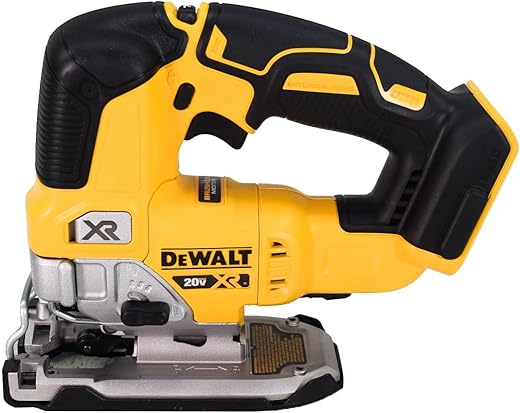

A Definitive, Report-Style Guide for DIY Woodworkers (Cut Quality, Control, Blades, and Safety)
The phrase “Best Jigsaws” is misleadingly simple. In woodworking, a jigsaw is rarely “best” because of raw speed alone—it’s “best” when it produces predictable, square cuts, tracks a line with minimal drift, controls tear-out on show faces, and does it all with manageable vibration, safe handling, and repeatable technique.
This long-form report synthesizes standards, safety guidance, manufacturer technical documentation, occupational vibration research, and cutting-mechanics literature to build a professional decision framework for choosing the best jigsaws for woodworking, the best wooden jigsaws (i.e., best jigsaws for cutting wood and wood composites), and the best jigsaw blade strategies for real shop outcomes.
1) Why “Best Jigsaws” is a systems problem
A jigsaw is a reciprocating cutting system where blade stiffness, guidance, stroke mechanics, orbital settings, feed pressure, material density, and workholding interact. This is why two woodworkers can use the same jigsaw and report opposite experiences: one gets crisp, square cuts; the other gets wander, burning, tear-out, and a blade that looks like it took a corner too fast.
Professional-grade outcomes come from aligning three layers:
- Machine capability (stability, power delivery, low runout, consistent stroke, base rigidity)
- Blade match (stiffness, tooth geometry, direction, material)
- Process discipline (layout, guide strategy, feed rate, orbital/speed settings, support)
Even manufacturer manuals explicitly frame orbital action as a trade-off: aggressive settings increase cutting efficiency but can roughen the cut and change the control feel. (festoolusa.com)
2) What actually drives cut quality in woodworking
When woodworkers say “this is one of the best jigsaws,” they usually mean some combination of:
A. Line tracking (anti-wander)
Wander is dominated by blade deflection. The jigsaw blade is slender and unsupported along most of its length; when you push feed pressure (or twist slightly), it bends and the cut exits off-angle.
Research and engineering discussions on jigsaw machine performance repeatedly flag blade guidance and deflection as core constraints, including the role of improved guiding elements in reducing deflection and improving precision. (Academia)
B. Squareness through thickness (top ≠ bottom)
A jigsaw can cut a perfect line on the top face while the underside drifts. This matters for template routing, joinery shoulders, plug inlays, scribe work, and visible edges.
C. Tear-out control (top face vs bottom face)
Tear-out is fundamentally tooth-exit mechanics and fiber support. You can reduce it via:
- Reverse-tooth blades (down-cut)
- Higher TPI / finer teeth
- Splinter guard inserts
- Painter’s tape / scoring
- Correct speed/orbit choices
Blade catalogs for woodworking commonly include reverse-tooth “splinter-free” options specifically for veneered/coated boards and laminates. (suttontools.s3-ap-southeast-2.amazonaws.com)
D. Surface finish (post-sanding burden)
Surface finish is influenced by tooth geometry, TPI, orbital settings, and vibration.
E. Control and fatigue (ergonomics + vibration)
Control is not just comfort: it’s the ability to maintain micro-corrections over a long curve or a controlled plunge without tipping. Vibration contributes directly to fatigue—and long-term exposure is a recognized occupational risk managed by standards and directives. (ISO)

3) Corded vs cordless (and why brushless matters)
Corded: stable power, often best for long duty cycles
Corded jigsaws remain attractive for:
- Thick hardwood work
- Continuous cutting sessions
- Shop benches with dust extraction already staged
Cordless: control freedom, but the platform matters
Modern cordless jigsaws can be fully professional—if the tool maintains speed under load and the battery platform supports the current draw.
Manufacturers list stroke rates, cutting capacities, and stroke length that let you compare “work potential” across platforms. For example, Makita’s 18V brushless jigsaws commonly sit in the ~26 mm stroke-length range with high SPM ceilings and wood capacities into triple digits (mm), signaling serious capability rather than “trim-only.” (makita.co.nz)
Brushless motors: efficiency and control, not just marketing
Brushless DC (BLDC) motor designs are widely characterized for efficiency, and industry reporting shows strong growth in brushless power tool segments due to performance/efficiency demand. (ResearchGate)
Practical woodworking meaning: a well-implemented brushless jigsaw is more likely to:
- Hold speed under load (less stall-induced wandering)
- Run longer per charge
- Produce more consistent cuts across a battery discharge curve
Festool, for instance, explicitly ties high stroke rate and torque delivery to its brushless motor platform in product documentation. (Festool Australia)
4) Orbital/pendulum action: productivity vs surface quality
Most “best jigsaws for woodworking” include multiple orbital/pendulum settings. Orbital action changes how the blade engages the kerf: it adds a forward component that increases material removal per stroke.
Manufacturer guidance is unambiguous:
- Higher orbital = faster, more aggressive cutting
- Lower orbital/off = better control and smoother results, especially in tight curves and fine finish work (festoolusa.com)
Academic and engineering literature also recognizes orbital motion as a productivity enhancer (in broader reciprocating-saw contexts). (ASME Digital Collection)
Woodworking rule of thumb (reliable in practice)
- Orbital 0 (off): tight curves, visible edges, laminates/veneers, template work
- Orbital 1–2: general curved cuts in solid wood where finish is secondary
- Orbital 3+: roughing, demolition-style cuts, thick stock, speed priority (expect more tear-out and more sanding)
5) Guidance, deflection, and why “square cuts” are hard for jigsaws
Jigsaws cut on the upstroke; the blade is pulled into the shoe and guided primarily near the clamp and roller. When you push too fast, the blade can bow behind the roller and exit off-angle.
Design-focused discussions on jigsaw performance highlight how additional guidance can reduce deflection and improve precision. (Academia)
What to look for in “best wooden jigsaws” (for wood cutting)
- Robust blade guide roller with minimal slop
- Stiffer blade clamp (repeatable seating)
- Minimal lateral play when the blade is installed
- A rigid shoe (baseplate) that doesn’t flex under hand pressure
The hidden culprit: blade selection
A premium jigsaw with a flimsy blade will still cut out of square. Wide “precision” blades and thicker backers reduce deflection. Practical woodworking guidance commonly recommends heavier-duty blades when squareness matters. (https://www.rockler.com/)
6) Baseplate engineering and bevel accuracy
Bevel cuts with a jigsaw are inherently tricky because:
- You’re tilting the reference plane
- Any blade drift is amplified
- Shoe rigidity and bevel lock accuracy become critical
Professional check: lock the shoe at 0°, insert a stiff/wide blade, and verify blade-to-shoe squareness at top and bottom of the stroke (tool unplugged). This diagnostic is a proven way to separate “tool alignment” from “operator technique.” (https://www.rockler.com/)
Decision point: if your work routinely requires accurate bevel joinery (not just rough beveling), you may be better served by track saw, bandsaw, or router-based workflows. A jigsaw can do it, but it is not the most reliable tool for precision bevel edges.

7) Dust management, sightlines, and lighting
Dust extraction isn’t just about cleanliness; it affects:
- Line visibility
- Blade cooling
- Cut accuracy (you can’t steer what you can’t see)
Higher-end jigsaws integrate extraction ports/adapters and airflow management as part of the system. Manufacturer documentation and manuals describe dust extraction adapters and integration with extractors. (festoolusa.com)
In practice, the best jigsaws for woodworking typically provide:
- A blower you can disable (when extraction is active)
- A clear sightline to the blade
- Useful LED placement (not a glare source)
8) Vibration: performance, health, and compliance context
Why vibration matters to woodworkers
Vibration impacts:
- Fatigue and control (immediate)
- Long-term health risk (cumulative)
Hand-arm vibration is assessed using internationally recognized measurement approaches (ISO 5349) and is the basis for many workplace vibration management practices. (ISO)
Regulatory context (EU example)
The EU Vibration Directive sets action and limit values standardized to an 8-hour reference period, guiding when employers must take mitigation steps. (EUR-Lex)
Real-world variability by tool type
Occupational safety research organizations note that vibration values can vary considerably by tool and usage conditions; jigsaws are explicitly among machines where variability can be significant depending on setup and operation. (dguv.de)
What this means for selecting “Best Jigsaws”
If two jigsaws cut equally well, prefer the one that:
- Produces less perceived vibration at comparable load
- Maintains control without a death grip
- Has better damping and ergonomics
Independent vibration measurement and risk management approaches are used in industry settings, reinforcing that vibration is measurable and manageable—not just “comfort.” (Reactec)
9) Jigsaw blade science: materials, tooth geometry, and use-cases
If the tool is the engine, the blade is the cutting geometry—and the blade determines whether you get:
- crisp veneers
- square edges
- fast rough cuts
- clean curves
- minimal burning in hardwood
Blade shank standardization (why T-shank dominates)
T-shank designs are widely described as providing secure grip and broad compatibility across modern jigsaws. (boschtools.com)
Blade material families (what matters in practice)
| Blade material | Typical use | Strengths | Tradeoffs |
|---|---|---|---|
| High Carbon Steel (HCS) | wood, soft materials | flexible, inexpensive | dulls faster in abrasive composites |
| High Speed Steel (HSS) | metal | heat resistance | brittle, not ideal for wood finish cuts |
| Bi-metal (HSS edge + flexible body) | mixed materials, tougher use | durability + flexibility | higher cost; can still wander if too thin |
| Carbide / carbide-grit | abrasive materials (cement board, fiberglass, etc.) | extreme wear resistance | expensive; not “fine woodworking finish” |
Manufacturer catalogs explicitly position tungsten carbide options for abrasive materials (fiber cement, fiberglass, etc.). (RS Components)
Independent blade guidance also explains why bi-metal blends toughness and edge retention for harder tasks and mixed cutting. (toolstoday.com)
10) Blade selection for woodworkers: “best jigsaw blade” by task
There is no single best jigsaw blade—there is a best blade for your cut objective. Use this objective-first approach:
A) Clean crosscuts in hardwood (visible edge)
Goal: minimal splintering + minimal sanding
Blade traits
- Higher TPI (finer teeth)
- Ground teeth for cleaner cut
- Lower orbital (often 0–1)
- Moderate stroke speed (too fast can scorch dense hardwood)
Technique
- Let the blade cut—don’t force feed
- Support both sides of the cut to reduce vibration
- Use a splinter insert and tape on the show face when needed
B) Splinter-free top surface in plywood/veneered panels
Goal: clean show face (especially on prefinished ply)
Blade traits
- Reverse-tooth (down-cut) blades push fibers down at the surface, reducing top splintering
- Often best with orbital off to avoid chip-out
Blade catalogs commonly define reverse-tooth blades as “splinter-free” solutions for laminated and veneered boards. (suttontools.s3-ap-southeast-2.amazonaws.com)
Tradeoff: down-cut blades can increase tear-out on the bottom face; plan your show-face orientation accordingly.
C) Fast rough sizing (construction-grade cuts)
Goal: speed
Blade traits
- Lower TPI, aggressive set
- Wider blade if you need straighter rough cuts
- Higher orbital settings for removal rate
Manufacturer manuals explicitly note higher orbital (pendulum) settings increase aggressiveness and efficiency. (festoolusa.com)
D) Tight curves, scroll work, inside cutouts
Goal: controllability in turns
Blade traits
- Narrow blade for tight radius
- Orbital off
- Higher TPI if edge quality matters
Technique
- Make relief cuts on tight internal radii
- Reduce speed when turning sharply to prevent blade twisting
E) Plunge cuts in sheet goods (cabinet cutouts)
Goal: safe entry + controlled line
Blade traits
- Plunge-friendly tip geometry (many catalogs highlight plunge features)
- Moderate TPI (balance speed/finish)
Industrial catalogs explicitly show design features such as exaggerated tips for plunge cuts. (RS Components)
11) A professional test protocol to compare jigsaws (in your shop)
To decide what truly qualifies as Best Jigsaws for your workflow, run controlled tests that reveal tracking, squareness, vibration, and finish.
Materials
- 18 mm Baltic birch ply (veneered)
- 30–40 mm hardwood (maple/oak)
- MDF (abrasive, shows heat and dulling)
Blades (standardize across tools)
- Fine clean wood blade (high TPI)
- Reverse-tooth (splinter control)
- Wide “precision” blade (anti-wander)
- Fast rough blade (low TPI)
Tests
- Straight cut with guide fence (500 mm)
- Evaluate: drift, ease of steering, burn marks
- Square-through-thickness cut (hardwood block)
- Measure top and bottom kerf alignment
- Tight radius curve
- Evaluate: blade twist tendency, controllability
- Veneer splinter test
- Compare top and bottom chip-out with reverse vs standard blade
- Fatigue/vibration session
- Same operator, same task duration; record subjective fatigue and control
Scoring
Weight categories by your real work:
- Template work? Weight squareness higher.
- Install work? Weight portability and control higher.
- Cabinet cutouts? Weight plunge stability and visibility higher.
This is the fastest way to turn “internet opinions” into a repeatable, professional selection.
12) Buying framework: what “best jigsaws for woodworking” means by job type
Category 1: Precision-first woodworking (templates, joinery fits, visible edges)
Prioritize:
- Blade guidance quality and stiffness
- Shoe rigidity and 0° calibration repeatability
- Orbital control that’s stable at setting 0
- Dust extraction integration
High-end jigsaw manuals emphasize orbital adjustability and extraction integration as part of precision workflows. (festoolusa.com)
Category 2: General shop jigsaw (curves, cutouts, fitting)
Prioritize:
- Ergonomics (handle style that gives you control)
- Quick blade changes
- Consistent speed control
Category 3: Jobsite and install (countertops, flooring, scribing)
Prioritize:
- Cordless platform power
- Visibility (blower/LED)
- Durability and guard integrity
Cordless brushless jigsaws with published high SPM and meaningful stroke lengths/capacities are credible “pro” choices rather than light-duty tools. (Makita USA)

13) Safety: guarding, workholding, PPE, and standards
Even for experienced DIY woodworkers, jigsaws create a risky combination: exposed blade, one-hand control temptation, and a workpiece that people often hold by hand “just for a quick cut.”
Core safety principles (non-negotiable)
- Clamp the workpiece. Portable saw guarding guidance notes the operator often holds the tool with one hand while the other secures stock—this is exactly where clamping and stable support prevent slips and loss of control. (Aspetti Lavoro)
- Use PPE (eye protection, hearing protection, and task-appropriate respiratory protection), consistent with general power-tool safety guidance. (Aspetti Lavoro)
- Inspect guards, cords/batteries, and blade tightness before cutting. (Salute e Sicurezza Ambientale)
Standards context (why it matters even in a home shop)
The IEC 62841-2-11 standard covers safety requirements for reciprocating saws including jigsaws, addressing hazards under normal use and reasonably foreseeable misuse. (IEC Webstore)
You don’t need to buy standards to benefit from the takeaway: choose tools that are designed and documented around modern safety requirements, and follow the manufacturer’s operating limits.
14) Maintenance and calibration to keep a jigsaw “best”
A jigsaw that was “best” out of the box can degrade into a frustrating wander machine if you ignore calibration and wear points.
Monthly (or after heavy use)
- Check shoe squareness at 0°
- Inspect the blade clamp for debris and wear
- Check the guide roller for play
- Inspect the baseplate lock for repeatable bevel settings
Blade discipline (the most overlooked performance lever)
- Don’t “finish cut” with a blade you used for roughing MDF
- Replace blades early when precision matters—dull blades increase feed pressure, heat, vibration, and drift
- Match blade stiffness to stock thickness
Key takeaways (executive summary)
- Best Jigsaws are defined less by brand and more by guidance rigidity, shoe accuracy, vibration behavior, and blade compatibility.
- Orbital action is a controlled trade: speed vs finish—manufacturer guidance explicitly frames it this way. (festoolusa.com)
- For woodworking, blade selection is the primary determinant of tear-out, squareness, and control—reverse-tooth and splinter-free designs exist specifically for veneered/laminated panels. (suttontools.s3-ap-southeast-2.amazonaws.com)
- Vibration is not just comfort; it’s linked to occupational assessment standards and directives—use it as a real selection criterion. (ISO)
- The most “definitive” way to choose is a short, controlled shop test protocol that scores drift, squareness, veneer tear-out, and fatigue.
FAQ
What are the best jigsaws for woodworking—corded or cordless?
Both can be “best.” Corded favors long duty cycles; cordless favors mobility and control. Choose cordless if it maintains speed under load and fits a strong battery platform; published specs (stroke length, SPM, capacity) help validate capability. (Makita USA)
What is the best jigsaw blade for splinter-free plywood cuts?
A reverse-tooth (down-cut) blade is a primary solution for a clean top surface on veneered/coated boards, often paired with orbital off and a splinter insert. (suttontools.s3-ap-southeast-2.amazonaws.com)
Why does my jigsaw cut straight on top but angled underneath?
Blade deflection and twist under load are common causes. Use a wider/stiffer blade, reduce feed pressure, reduce orbital action, and confirm shoe/blade alignment. (https://www.rockler.com/)
Does orbital action make cuts less accurate?
Orbital action increases aggressiveness and removal rate, which can worsen surface quality and reduce fine control. Many manuals explicitly warn that higher orbital settings produce rougher cuts. (festoolusa.com)
How do I reduce vibration when using a jigsaw?
Use sharp blades, clamp the work, avoid forcing feed, and choose tools with better vibration behavior. Vibration is a recognized exposure factor assessed under ISO-based approaches. (ISO)
Check out these products:
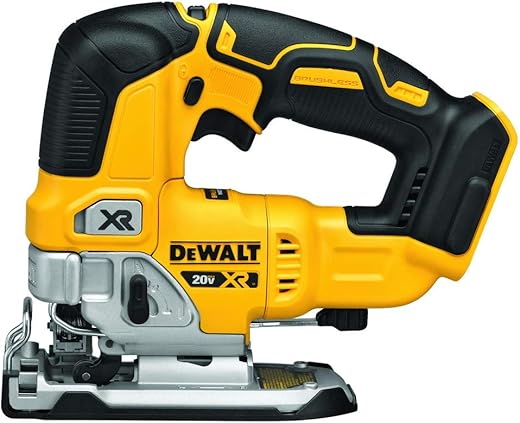
- Brushless motor of the cordless jigsaw delivers efficient performance for longer runtime (vs. DCS331 Jig Saw)
- Compact size for easy grip and maximum control of the jig saw
- Bright LED on the jigsaw tool helps illuminate dimly lit work surfaces
- Variable speed trigger and dial provide precise speed control
- All-metal, lever-action keyless blade change allows for quick and easy t-shank blade changes
- Integrated dust blower helps clear line of sight while cutting
- 4-position orbital action provides control of cut quality and speed
- All-metal, keyless shoe bevel with detents at 0 degree, 15 degree, 30 degree, and a positive stop at 45 degree for easy adjustment
- No-mar shoe cover to help protect work surface from scratches
- Accepts t-shank jig saw blades for optimal holding power and professional results
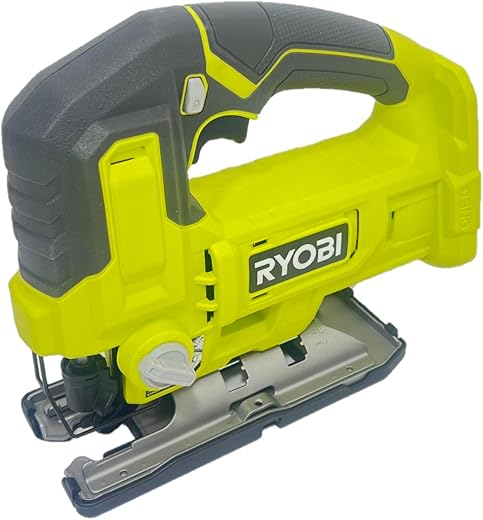
- 4 orbital settings to match power to application
- Non-marring shoe protects work surface
- Variable speed trigger for precise speed control
- Base adjusts from 0° to 45° right or left
- Quick and easy blade changes with tool-free blade release
- Fast, precise cutting with 0 - 3,000 SPM
- On-board LED worklight
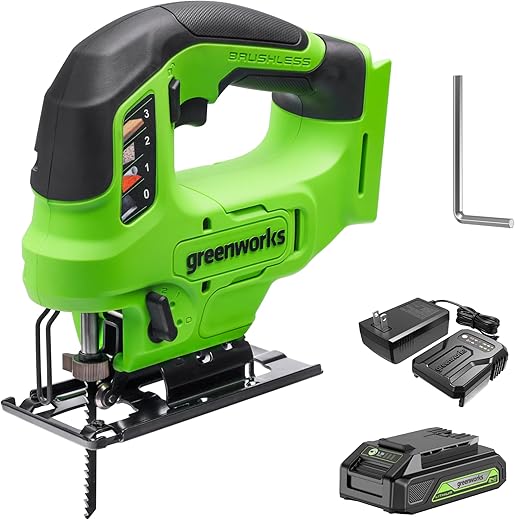
- Powerful & Durable: Greenworks 24V lithium-ion battery delivers more power and longer runtime than most other 20V and 18V tools. The high-performance brushless motor provides more torque and cooler operation at high speeds, enhanced battery runtime and longer service life.
- Variable Speed Trigger (0-3000 SPM): Provides control for accurate and clean cuts in different applications. 1" Blade stroke for cutting wood, metal and more materials.
- 4 Orbital Setting: Adjusts cutting speed and aggressiveness for wide use of the jig saw. Shoe bevel with detents at 0°, 15°, 30° and 45°(Right and left ) for easy adjustment.Tool-free Quick Clamp allows for easy blade change.
- Built-in LED Light illuminates poorly lit surfaces. Included dust connector can be connected to a vacuum to keep a clean working enviornment.
- We've got your back: Greenworks power tools come with 3-year tool & 2-year battery limited warranty and friendly customer service.
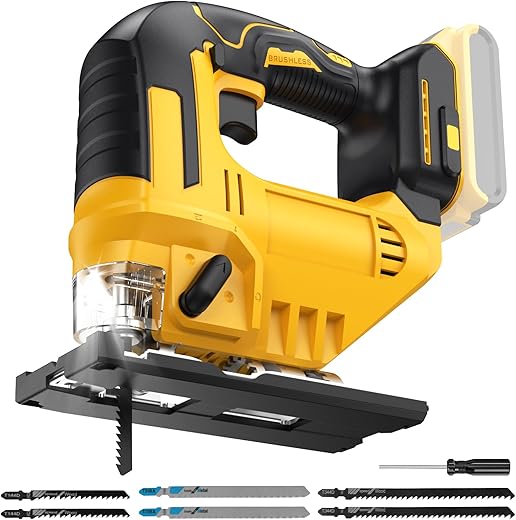
- Compatible with Dewalt 20V MAX Battery: This cordless jigsaw compatible with DeWalt 20V Max batteries (DCB200, DCB201, DCB203, DCB204, DCB205, DCB206 and more), offering portability and freedom from cords. It ensures wire-free convenience and extended runtime for indoor/outdoor projects. Note: Battery not included.
- High-Performance Brushless Motor & Variable Speed: Equipped with a brushless motor, the jigsaw tool delivers up to 2900 RPM for efficient cutting, while low-voltage and overload protection ensure durability. Adjustable speed settings (0-3000 SPM) adapt to wood, metal, PVC, and plywood, etc.
- 45° Bevel & 3-Position Orbital Action: Achieve precise 0°-45° bi-directional bevel cuts and switch between 3 orbital settings (0-2) for optimized performance on straight, curved, or plunge cuts. Max cutting depth: 135mm (wood) and 10mm (steel).
- Safety Lock & Tool-Free Blade Change: The all-metal lever-action system enables quick blade swaps without tools, while the safety lock button prevents accidental activation. A built-in LED light illuminates dark workspaces for enhanced accuracy.
- Ergonomic Design & Comprehensive Kit: Featuring a rubberized anti-slip handle and lightweight body (3.75 lbs), this jig saw reduces fatigue during extended use. Includes 6 T-shank blades (wood/metal), screwdriver, and a detailed manual.
- Versatile for DIY & Professional Projects: Ideal for home improvement, carpentry, and metalworking, this cordless jigsaw combines power and precision. Compatible with Dewalt 20V MAX platforms, it’s perfect for intricate cuts in confined spaces or outdoor job sites.
- Item Package Quantity - 1
- Product Type - SAW
- This pre-owned product has been professionally inspected, tested and cleaned by Amazon qualified vendors.
- Accessories may not be original, but will be compatible and fully functional. Product may come in generic box.
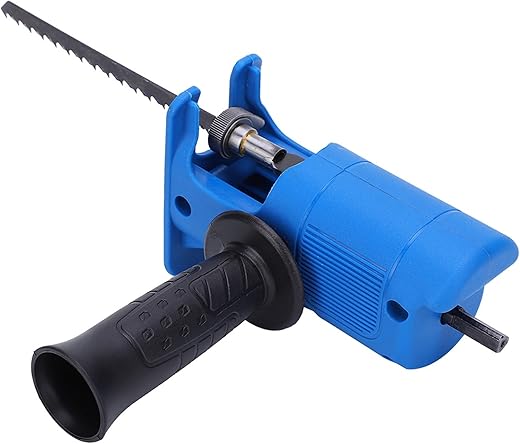
- Transform Your Drill: This Electric Reciprocating Saw serves as a versatile attachment that converts your standard electric drill into a powerful reciprocating saw. By utilizing your existing drill, you save space and eliminate the need for additional bulky tools. This innovative design allows you to seamlessly switch from drilling to cutting, making it an essential addition to your tool collection for various projects, whether at home or in a workshop
- Lightweight and Portable: Unlike traditional electric saws, this reciprocating saw is designed to be lightweight, making it easy to transport and maneuver. Its compact size ensures that you can carry it comfortably to job sites without feeling burdened. This portability makes it ideal for both professional contractors and DIY enthusiasts who need convenient tools that can go wherever they are needed
- Sturdy Construction: Crafted from high-quality ABS and high-speed steel, the Electric Reciprocating Saw is not only built for durability but also ensures safety during use. The materials used are eco-friendly and designed to withstand the rigors of heavy-duty cutting tasks. Enjoy peace of mind knowing that you are using a product made with safety and longevity in mind, suitable for both wood and metal applications
- Easy Installation and Usage: Featuring a user-friendly handle that is easy to install and disassemble, this reciprocating saw is designed for convenience. The non-slip grip ensures that you maintain complete control while cutting, reducing the risk of accidents. Whether you're a seasoned pro or a beginner, you'll find this tool intuitive and straightforward to operate, making your cutting tasks quicker and more efficient
- Versatile Cutting Capabilities: This Electric Reciprocating Saw comes with three saw blade options that allow you to tackle a variety of cutting tasks ranging from wood to metal. With cutting sizes of approximately 150mm, 130mm, and 100mm, you have the flexibility to choose the appropriate blade for your specific project. This adaptability makes it a go-to tool for both household needs and professional use, ensuring that you can cut with precision and ease

- This item is Factory Reconditioned, some show more wear than others
- Battery and Charger SOLD SEPARATELY
- Fast, precise cutting with 0 - 3,000 SPM
- 30% reduced vibration enhances cut control
- Non-marring shoe protects work surface
- Quick and easy blade changes with tool-free blade release
- Variable speed trigger for precise speed control
- 4 orbital settings to match power to application
- Base adjusts from 0° to 45° right or left
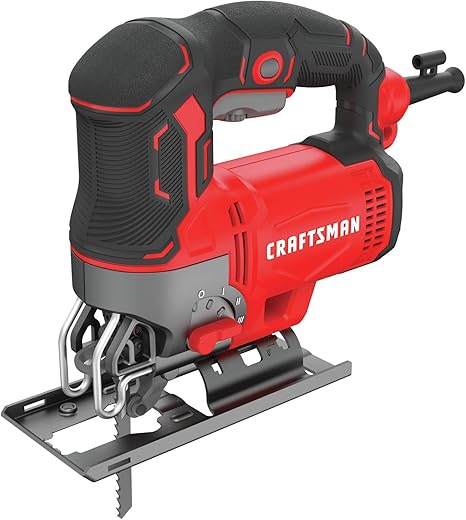
- Variable speed trigger ranging from 03, 200 spm's provides control for clean and accurate cuts
- 4Orbital settings to adjust cut aggressiveness for various materials and applications
- Beveling shoe provides ability to cut up to 45 deg. For angled cuts
- Contoured overmolded handle for added comfort during use
- Compatible with the versa-track wall organization system. Hook and Accessories sold separately.
- 3 Year Limited Warranty, refer to "Warranty & Support" section below for full details
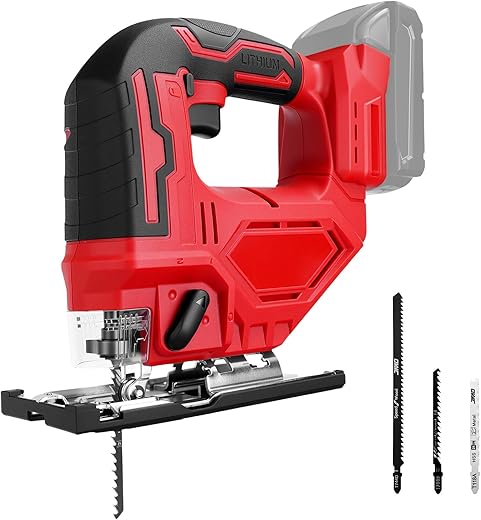
- NOTE: NO BATTERY, TOOL ONLY
- 【Bevel Cutting & 3 Orbital Settings】 The maximum cutting angle of the jigsaw is ±45°. 45° bi-directional chamfers for various cutting angles and making the corners fit better. There are 3-position adjustable track settings, which is convenient for cutting at various angles on different materials
- 【Compatible Battery】The cordless design makes the jigsaw easy to carry and suitable for use on different job sites. This Jig Saw compatible For Milwaukee 14.4V-18V MAX Li-ion battery model: 48-11-1811 48-11-1840 48-11-1850 2620 2630 48-11-1811, 48-11-1815, 48-11-1820, 48-11- 1822, 48-11-1828, 48-11-1840(Tool Only, No Battery)
- 【High Speed Cutting & Variable Speed】Equipped with a high performance motor to provide constant and stable cutting force, the variable speed control from 0-2700 RPM allows for fast cutting to meet the needs of a wide range of materials and applications
- 【Tool-free Blade Change】This Jig saw with three blades has a self-locking collect for safe and quick manual blade changes without additional tools
- 【High Safety】Designed with safety lock and LED light to avoid operating accidents and ensure safe operation. In addition, the ergonomic rubberized handle makes your operation more comfortable, ensuring both comfort and safety
- 【Products Contained】Equipped with three saw blades (1*100mm curve cutting saw blade, 1*180mm wood saw blade, 1*75mm metal saw blade) The maximum cutting depth of the wood saw blade is 130mm The metal saw blade cutting depth is 1-3mm